
A pest control CIM example,
a complete sample.
Browse real pages from a complete confidential information memorandum for a fictional pest control company, made with Deliverables AI. See how to present recurring customers, retention, routes and licensing.
Free trial, no credit card. Plans start at $49 a month.
Quillfeather Pest Control is a fictional company. Pages shown are from a CIM made with Deliverables AI.
About this sample
A fictional company, start to finish.
Quillfeather is invented for this sample, along with its owner, technicians, customers and every number. The CIM is 46 pages and was made from a company write-up, three years of financial statements and an employee roster.
The business
A residential and light commercial pest control company in a fictional part of the Tampa Bay area of Florida, founded in 2012.
Size
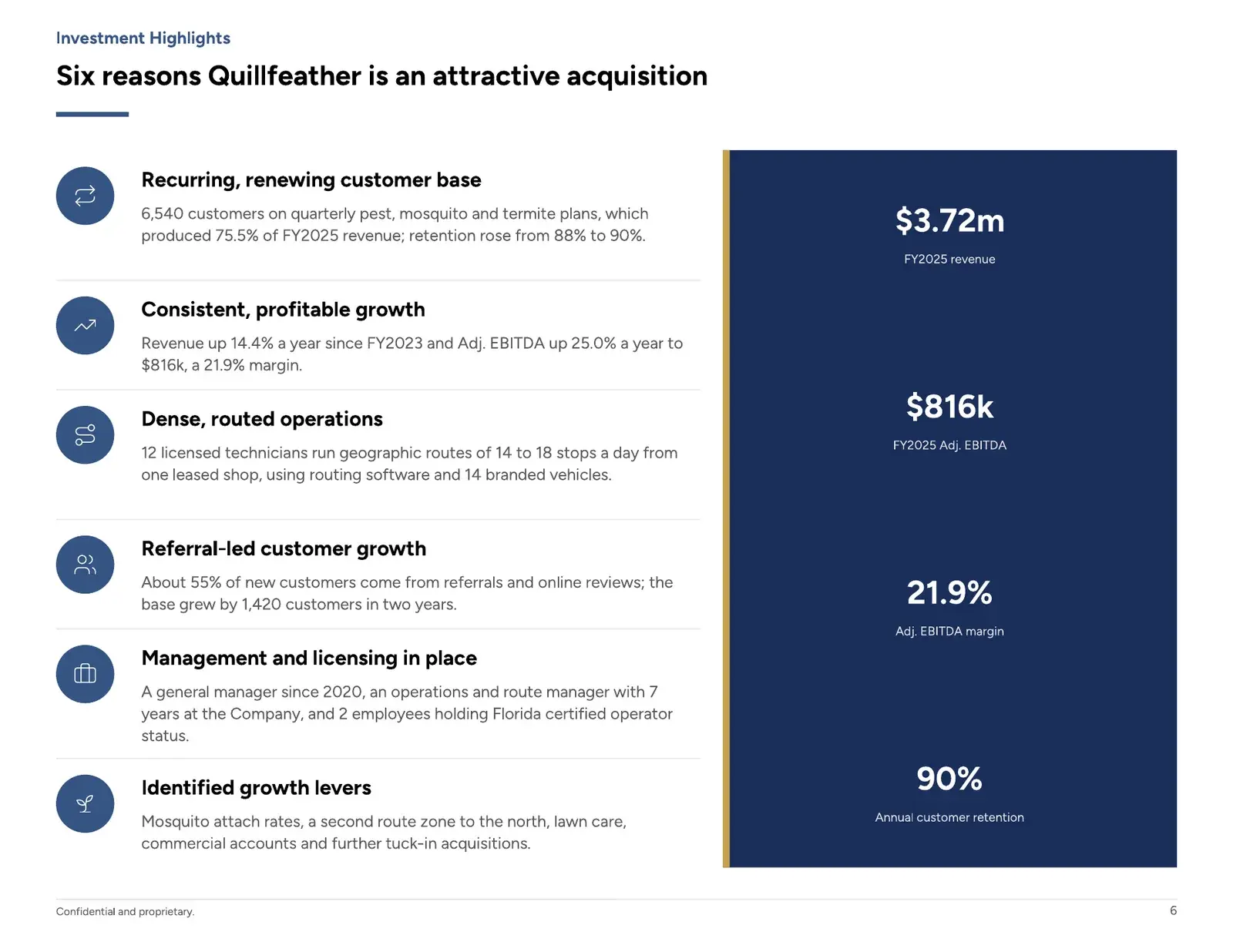
$3.72m of revenue in FY2025, 22 employees and 12 licensed technicians.
Earnings
$816k of adjusted EBITDA in FY2025, a 21.9% margin, reconciled from reported pre-tax income.
Recurring base
6,540 recurring customers at the end of FY2025, retained at 90% a year, about 76% of revenue.
Revenue mix
Quarterly pest plans 42%, mosquito 17%, termite renewals 16%, rodent and wildlife 13%, commercial 11%.
The deal
An asset sale with a 6-month paid transition, including a plan for the certified operator. No price is stated.
What buyers look for
Six things a buyer checks in a pest control company.
Pest control is valued for its recurring routes. Buyers look at how many customers are on a plan, how long they stay and how efficiently technicians cover them.
The recurring customer base
Count customers on quarterly, monthly or annual plans at each year end, and show recurring revenue as a share of the total. One-time jobs are useful but are not what a buyer is paying for.
Retention
Annual customer retention is the single number buyers look at first. Show it over several years and explain what is behind any change.
Route density and technician capacity
Customers close together mean more stops per day. Buyers ask how routes are built, how many stops a technician does, and whether there is room to add customers without adding trucks.
Licensing and certified operators
Pest control is a licensed trade, and in many states the business license depends on a certified individual. Say who holds certification, and how it will carry through a sale.
Customer acquisition and add-on services
Referrals, reviews, online search and door-to-door programs cost different amounts. Buyers also look at how many customers add mosquito or termite plans, and what obligations termite warranties create.
Acquired books and quality of earnings
If the owner bought customer lists in the past, show how those customers have retained. As with any small business, owner pay is replaced with a manager's cost and personal and one-time items are removed.
Notices and executive summary
Confidentiality terms, then the business, its recurring base and the reason for sale, so a buyer can decide quickly whether to read on.
Investment highlights
Six reasons to buy, each tied to a number that appears later in the book.
Services and revenue mix
Quarterly pest plans, mosquito, termite, rodent and wildlife, and commercial accounts, each with revenue and growth.
Recurring customers and retention
Customers at each year end, retention, where new customers come from, and the performance of acquired customer books.
Route operations and licensing
How a customer moves from first call to renewal, route design, the fleet and the certified operator structure.
People and management
The general manager and route manager, an org chart and a roster by role with pay basis and tenure.
Growth opportunities and market
Levers the owner has identified, including tuck-in acquisitions, and a short market page where outside figures name their source.
Financial overview, risks and transaction
Income statement, adjusted EBITDA reconciliation, buyer considerations and how each is addressed, and the deal terms.
The request
That sample came from three files and one request.
I'm helping the owner of Quillfeather Pest Control sell the business. Please treat everything in the attached files (company background, financial statements with the seller's add-backs, and an employee roster) as the full data room. Create a complete confidential information memorandum (CIM) for prospective buyers. It should read like a real CIM from a business broker: executive summary and investment highlights, company overview and history, services and revenue mix, the recurring customer base and retention, route operations and licensing, people, growth opportunities including tuck-in acquisitions, market overview, financial overview with the owner's add-backs and adjusted EBITDA reconciliation, key risks and how they are addressed, and the transaction overview. Do not state an asking price or valuation. Use only the facts and numbers in the files. Check that every number reconciles across slides.
The files were a company write-up, a three-year income statement with the accountant's add-backs and a roster, all invented for this sample. The request also asked for the default visual style and a full book without design questions.
Your part
What you still do before it goes to a buyer.
Supply what the files leave out
The sample flags what it was not given, such as the full balance sheet, customer-level retention data and termite warranty terms. Gather these before buyers ask.
Support the add-backs
Keep the payroll records, receipts and legal documents behind each adjustment, and expect a buyer's accountant to tie your statements to bank records.
Check every figure against your books
Read the financial pages against your own records before anything goes out. The draft ties to the files it was given and is only as accurate as they are.
Confirm licensing with your regulator
How a pest control license and certification transfer in a sale depends on your state. Check with your state regulator, and get advice from a broker and an attorney.
Pricing
Start free, then pay monthly.
Up to 5,000 credits · 30 days · no credit card. Every plan includes a monthly pool of credits that your work uses.
Larger plans and top-off credits are on the pricing page.
Your turn
Make yours from your own files.
Upload your company write-up and financial statements, and review a full draft memorandum that you can export as PowerPoint or PDF.
Before you start
A few useful answers.
What is a CIM for a pest control company?
A confidential information memorandum is the document a seller or broker gives to qualified buyers after they sign a confidentiality agreement. For a pest control company it covers the recurring customer base, services and revenue mix, routes, licensing, financials with adjustments, risks and the terms of the sale.
Is Quillfeather Pest Control a real company?
No. The company, its owner, technicians, customers and every number are made up for this sample. The pages show structure and depth, not figures to copy or benchmarks for your own business.
How should I show retention?
The sample shows annual retention for three years next to customers at each year end, and says how customers are counted. Buyers will ask how you measure it, so state the definition.
How do I show customer lists I have bought?
The sample describes two small customer books bought earlier, how many customers came with them and how they have retained, so a buyer can judge whether acquisitions have worked for the company.
What do I need to start?
A short write-up of the business, your income statements and a staff roster, ideally with add-backs. Anything missing is flagged as an open item instead of invented.
Do I need a credit card to try it?
No. The free trial needs no credit card. The plans above are monthly.
HVAC CIM example
Copperfield Heating & Air, a fictional company.
Dental practice CIM example
Quillstone Family Dental, a fictional company.
Auto body shop CIM example
Ironbridge Collision Center, a fictional company.
Veterinary practice CIM example
Thistledown Veterinary Hospital, a fictional company.
Landscaping CIM example
Stonegate Landscape & Snow, a fictional company.
Plumbing company CIM example
Wrenmoor Plumbing & Drain, a fictional company.
Insurance agency CIM example
Ashlar Ridge Insurance Group, a fictional company.
IT managed services CIM example
Kestrelpoint Managed IT, a fictional company.
Light manufacturing CIM example
Alderbrook Plastics, a fictional company.
Laundromat business CIM example
Brightwater Laundry Co., a fictional company.
Car wash CIM example
Suncrest Express Wash, a fictional company.
Gas station and convenience store CIM example
Marlow Crossing Fuel & Market, a fictional company.
Vending business CIM example
Tallgrass Vending, a fictional company.
Restaurant CIM example
Larkspur Table, a fictional company.
Liquor store CIM example
Hollis Wine & Spirits, a fictional company.
Coffee shop CIM example
Ember & Oak Coffee, a fictional company.
Daycare center CIM example
Little Birch Learning Center, a fictional company.
Bar and grill CIM example
The Copper Lantern Tavern, a fictional company.
Gym CIM example
Ironwood Fitness, a fictional company.