
A laundromat CIM example,
a complete sample.
Browse real pages from a complete confidential information memorandum for a fictional three-store laundromat company, made with Deliverables AI. See how to present stores, machines, utilities, payments and leases.
Free trial, no credit card. Plans start at $49 a month.
Brightwater Laundry Co. is a fictional company. Pages shown are from a CIM made with Deliverables AI.
About this sample
A fictional company, start to finish.
Brightwater Laundry Co is invented for this sample, along with its owner, employees, customers and every number. The CIM is 49 pages and was made from a company write-up, three years of financial statements and an employee roster.
The business
Three attended laundromats in a fictional city in central Ohio, founded in 2006, with self-service machines, wash-dry-fold and a small commercial route.
Size
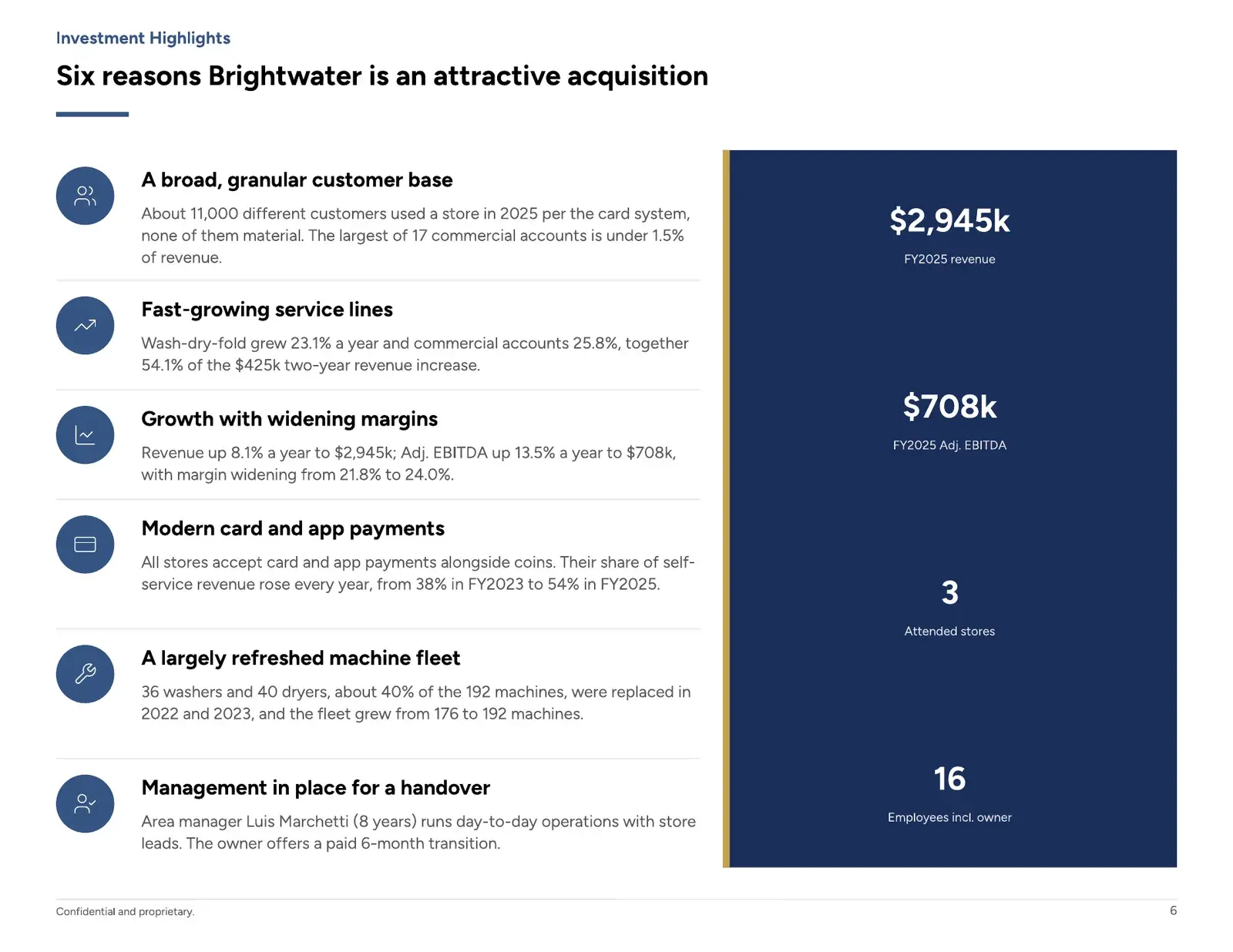
$2.95m of revenue in FY2025, 192 washers and dryers, about 11,000 customers on the card system and 16 employees.
Earnings
$708k of adjusted EBITDA in FY2025, a 24.0% margin, reconciled from reported pre-tax income.
Payments
Card and app payments were 54% of self-service revenue in FY2025, up from 38% two years earlier.
Revenue mix
Self-service washers 51%, dryers 24%, wash-dry-fold 16%, commercial accounts 6%, vending and other 3%.
The deal
An asset sale with lease assignments subject to landlord consent and a 6-month paid transition. No price is stated.
What buyers look for
Six things a buyer checks in a laundromat.
Laundromats are bought for their stores, their machines and their steady cash flow. A CIM should show store-level reality and what the owner actually does all week.
Utilities, water and gas
Utilities are usually the largest cost. Show them by store over several years as a share of revenue, how rates are billed and which dryers run on gas or electricity.
Machine age and repair spend
Buyers want the fleet by age and size, what was replaced recently, annual repair cost and what a replacement cycle would cost over the next few years.
Leases and landlord consent
Revenue is only as secure as the lease. List term, options and rent by store, say whether any landlord is related to the owner, and show how assignment works.
How much runs without the owner
Attended stores, shift leads and a manager who already runs the week make the business transferable. Absentee ownership claims need the roster to back them up.
Payment systems and revenue records
Card and app systems create records that coins never did. Show the share of revenue they carry and what the system reports on customers and usage.
Service lines beyond self-service
Wash-dry-fold and commercial routes add recurring revenue but need labor and a driver. Show their growth, pricing basis and the capacity left in the plant.
Notices and executive summary
Confidentiality terms, then the business, its stores and the reason for sale, so a buyer can decide quickly whether to read on.
Investment highlights
Six reasons to buy, each tied to a number that appears later in the book.
Store operations and equipment
Hours, attendance, the machine fleet by age, and store-level costs as a share of revenue.
Customers and revenue streams
Self-service, wash-dry-fold and commercial accounts, each with revenue and growth, and a plain page on customer concentration.
Payment systems and utilities
Card and app share by year, system fees, and utility cost as a share of revenue.
People, facilities and leases
The area manager, an org chart, a roster by role, and the three stores with lease terms.
Growth opportunities and market
Levers the owner has identified, and a short market page where outside figures name their source.
Financial overview, risks and transaction
Income statement, adjusted EBITDA reconciliation, buyer considerations and how each is addressed, and the planned owner handover.
The request
That sample came from three files and one request.
I'm helping the owner of Brightwater Laundry Co. sell the business. This is a fictional company used for a public sample, so please treat everything in the attached files (company background, financial statements with the seller's add-backs, and an employee roster) as the full data room. Create a complete confidential information memorandum (CIM) for prospective buyers of a multi-store laundromat business. It should read like a real CIM from a business broker, 40 to 50 pages: executive summary and investment highlights, company overview and history, store operations and equipment, customers and revenue streams (self-service, wash-dry-fold, commercial accounts), payment systems, utilities, leases, people, facilities, growth opportunities, market overview, financial overview with the owner's add-backs and adjusted EBITDA reconciliation, key risks and how they are addressed, and the transaction overview. Do not state an asking price or valuation. Use only the facts and numbers in the files; add general industry context only if it is accurate and you cite a primary source for any figure, otherwise leave it out. Check that every number reconciles across slides and with the files, and do not leave placeholders such as TBC anywhere; if a fact a buyer would expect is missing, say so briefly as an open item or leave it out. Mark the cover and closing page clearly as a fictional sample company for illustration. Build it as a polished deck I can export as PDF and PowerPoint. To save a round trip: use your default workspace style, US Letter landscape, Figtree, designed pattern pages instead of photography, and build the full book now without asking me design questions.
The files were a company write-up, a three-year income statement with the accountant's add-backs and a roster, all invented for this sample. The request names the sections a laundromat buyer expects and asks for numbers to reconcile.
Your part
What you still do before it goes to a buyer.
Supply what the files leave out
The sample lists what it was not given, such as store-level results, lease expiry dates, a machine list and card-system contract terms. Gather these before buyers ask.
Support the add-backs
Keep payroll records, receipts and the lease behind each adjustment, and expect a buyer's accountant to tie your statements to bank records.
Check every figure against your books
Read the financial pages against your own records before anything goes out. The draft ties to the files it was given and is only as accurate as they are.
Check leases and the sale structure
Landlord consent and any related-party lease matter to the deal. Read them, and get advice from a broker and an attorney.
Pricing
Start free, then pay monthly.
Up to 5,000 credits · 30 days · no credit card. Every plan includes a monthly pool of credits that your work uses.
Larger plans and top-off credits are on the pricing page.
Your turn
Make yours from your own files.
Upload your company write-up and financial statements, and review a full draft memorandum that you can export as PowerPoint or PDF.
Before you start
A few useful answers.
What is a CIM for a laundromat?
A confidential information memorandum is the document a seller or broker gives to qualified buyers after they sign a confidentiality agreement. For a laundromat business it covers the stores and machines, customers and revenue streams, utilities, payment systems, leases, people, financials with adjustments, risks and the terms of the sale.
Is Brightwater Laundry Co. a real company?
No. The company, its owner, employees and every number are made up for this sample. The pages show structure and depth, not figures to copy or benchmarks for your own business.
Does it work for a single store?
The sample is a three-store company, and the page shows only what that sample shows. A single store has the same questions about machines, utilities, the lease and who runs it, and you can try your own in the free trial.
Should I show utility costs plainly?
The sample gives utilities their own page, by year and as a share of revenue. Buyers will work them out from your statements in any case.
What do I need to start?
A short write-up of the business, your income statements and a staff roster, ideally with add-backs. Anything missing is flagged as an open item instead of invented.
Do I need a credit card to try it?
No. The free trial needs no credit card. The plans above are monthly.
HVAC CIM example
Copperfield Heating & Air, a fictional company.
Dental practice CIM example
Quillstone Family Dental, a fictional company.
Auto body shop CIM example
Ironbridge Collision Center, a fictional company.
Veterinary practice CIM example
Thistledown Veterinary Hospital, a fictional company.
Landscaping CIM example
Stonegate Landscape & Snow, a fictional company.
Plumbing company CIM example
Wrenmoor Plumbing & Drain, a fictional company.
Pest control company CIM example
Quillfeather Pest Control, a fictional company.
Insurance agency CIM example
Ashlar Ridge Insurance Group, a fictional company.
IT managed services CIM example
Kestrelpoint Managed IT, a fictional company.
Light manufacturing CIM example
Alderbrook Plastics, a fictional company.
Car wash CIM example
Suncrest Express Wash, a fictional company.
Gas station and convenience store CIM example
Marlow Crossing Fuel & Market, a fictional company.
Vending business CIM example
Tallgrass Vending, a fictional company.
Restaurant CIM example
Larkspur Table, a fictional company.
Liquor store CIM example
Hollis Wine & Spirits, a fictional company.
Coffee shop CIM example
Ember & Oak Coffee, a fictional company.
Daycare center CIM example
Little Birch Learning Center, a fictional company.
Bar and grill CIM example
The Copper Lantern Tavern, a fictional company.
Gym CIM example
Ironwood Fitness, a fictional company.