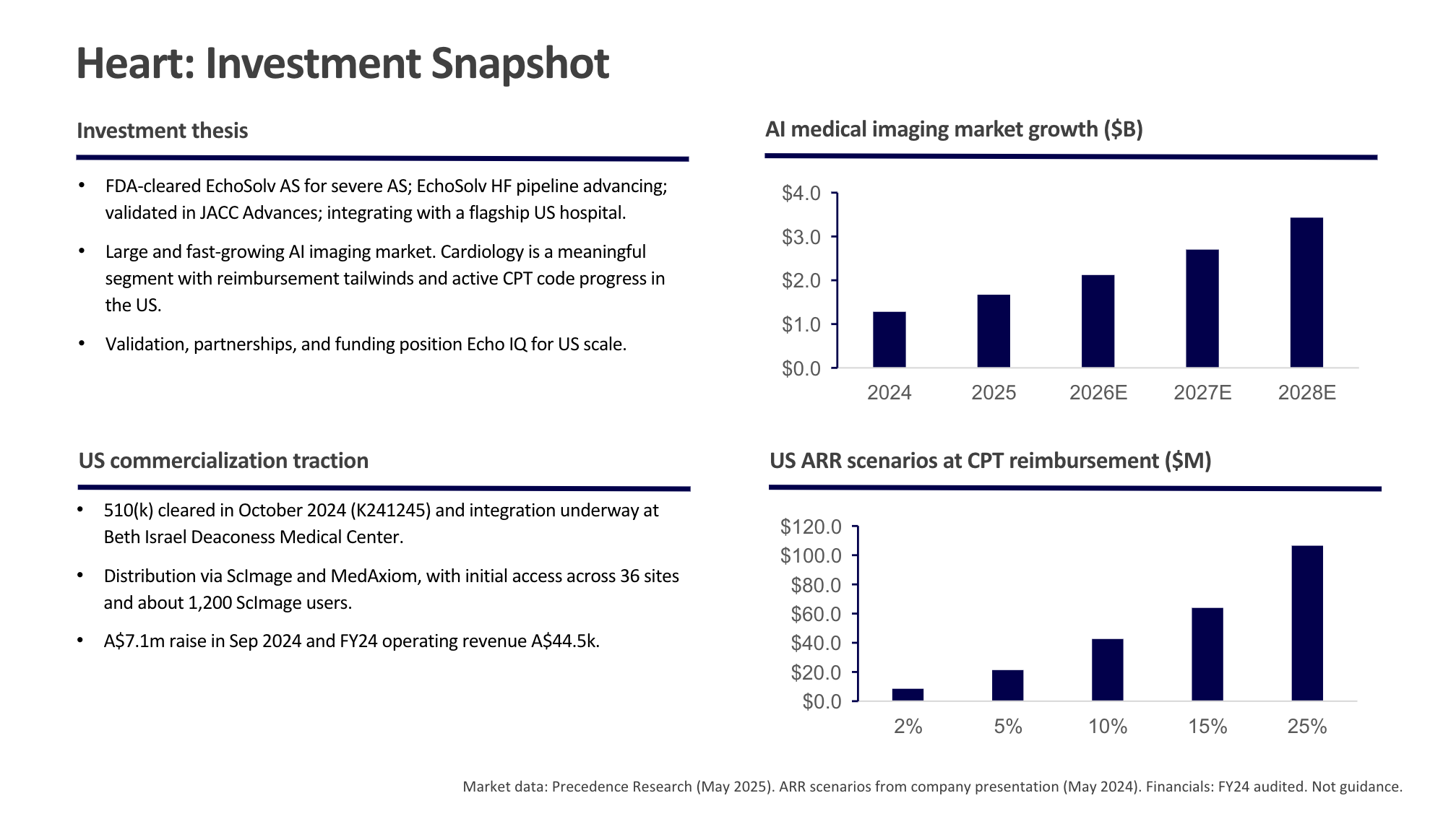
What is an investment memo? (Definition & overview)
An investment memo is an internal document that articulates the case for or against an investment opportunity. It synthesizes market analysis, financial projections, competitive positioning, and risk assessment into a concise recommendation for investment committees, partners, or senior management.
Key characteristics
- Decision-Oriented: Presents a clear recommendation (invest, pass, or further diligence)
- Evidence-Based: Supports claims with data, market research, and financial analysis
- Risk-Balanced: Identifies both upside potential and downside risks
- Audience-Specific: Tailored to the investment committee's priorities and decision criteria
Investment memos appear across the investment landscape—from venture capital firms evaluating seed-stage startups to private equity teams analyzing buyout targets to corporate development groups assessing strategic acquisitions. The format varies by context, but the core purpose remains consistent: enable informed, efficient investment decisions.
Why investment memos matter
Structured decision-making
Investment memos force disciplined thinking. By requiring analysts to articulate investment thesis, supporting evidence, and risk factors in writing, memos surface logical gaps and unexamined assumptions before capital is deployed. Written documentation creates accountability—decisions can be reviewed against original assumptions to improve future judgment.
Efficient communication
Investment committees review multiple opportunities per meeting. A well-structured memo allows busy partners or executives to quickly grasp the opportunity, evaluate merits, and identify questions—often before the presentation. This accelerates discussions and focuses meeting time on critical decision points rather than background exposition.
Institutional knowledge
Investment memos create a searchable archive of deal analysis. Future teams can reference past evaluations to understand investment criteria evolution, learn from successful patterns, and avoid repeating mistakes. When considering follow-on investments or similar opportunities, historical memos provide invaluable context.
Alignment and buy-in
The memo development process often involves input from multiple stakeholders—sector experts, operating partners, financial analysts. This collaborative creation builds consensus and ensures diverse perspectives inform the final recommendation. The result: stronger decisions and broader organizational support.
How to write an investment memo
Quick steps
- Define the opportunity: Company, stage, proposed transaction structure
- Develop investment thesis: Core value drivers in 2-3 sentences
- Analyze systematically: Market, competition, financials, team, risks
- Model returns: Base case, upside, downside scenarios with clear assumptions
- Articulate recommendation: Clear yes/no with supporting rationale
1. Executive summary & investment thesis
Executive Summary (1 page max)
Open with the essential facts that frame the decision:
- Company name, sector, stage/size
- Proposed transaction (equity stake, check size, valuation, structure)
- Key metrics (revenue, growth rate, margins, unit economics)
- Investment thesis (2-3 sentences on why this is compelling)
- Recommendation and expected returns
Your thesis should answer: "What unique insight or advantage makes this opportunity attractive?" Strong theses connect company strengths to market opportunities while acknowledging key risks.
Investment Thesis Examples:
❌ Weak: "GrowthCo is a fast-growing SaaS company in an attractive market."
✅ Strong: "GrowthCo's vertical SaaS platform dominates the $2B dental practice management market (30% share) with 140% NDR and locked-in multi-year contracts. Given high switching costs and expansion into adjacent verticals, we project 35% revenue CAGR with path to 45% EBITDA margins, supporting a 3.5x MOIC at conservative 12x EV/Revenue exit."
Deliverables AI Prompt: "Create an investment thesis for {{company_name}} in the {{sector}}. Highlight their competitive advantage, market position ({{metric}}), growth trajectory, and expected returns. Connect strengths to market opportunity while acknowledging 1-2 key risks. Keep to 3 sentences max."
2. Company & market overview
Company Background
- Founding story, mission, and current status
- Products/services and business model
- Customer base and geographic footprint
- Organizational structure and team size
Market Opportunity
- Total addressable market (TAM) with credible sources
- Market growth drivers and secular trends
- Market structure (fragmented vs consolidated)
- Regulatory or technological tailwinds
Be specific with market sizing. "Large market" means nothing; "$12B TAM growing 8% annually (Gartner 2024)" provides decision-relevant context.
Target Customer Analysis
- Customer segments and personas
- Pain points the product addresses
- Buying process and decision-makers
- Customer acquisition and retention metrics
Deliverables AI Prompt: "Analyze the market opportunity for {{company_name}} in {{sector}}. Provide TAM/SAM/SOM estimates with sources, identify 3-4 key growth drivers, describe target customer segments, and explain how {{company_name}}'s positioning captures this opportunity."
3. Competitive landscape & differentiation
Competitive Analysis Identify direct competitors, adjacent players, and potential disruptors. For each major competitor, note:
- Market position and estimated share
- Product/service offerings
- Go-to-market strategy
- Relative strengths and weaknesses
Differentiation & Moat Explain why customers choose this company over alternatives:
- Product/technology advantages
- Brand strength or network effects
- Cost structure benefits
- Strategic partnerships or distribution
- Proprietary data or IP
Support claims with evidence: customer win rates, NPS scores, feature comparisons, pricing power, retention metrics.
Competitive Positioning Matrix
quadrantChart
  title Market Positioning Analysis
  x-axis Low Features --> High Features
  y-axis Low Price --> High Price
  quadrant-1 Premium Leaders
  quadrant-2 Value Players
  quadrant-3 Budget Options
  quadrant-4 Feature Leaders
  Target Company: [0.75, 0.80]
  Competitor A: [0.70, 0.55]
  Competitor B: [0.45, 0.35]
  Legacy Player: [0.30, 0.55]
  New Entrant: [0.65, 0.25]
4. Financial analysis & projections
Historical Performance Present 3-5 years of historical financials:
- Revenue growth and composition
- Gross margin trends
- Operating expenses as % of revenue
- EBITDA/cash flow generation
- Balance sheet health and working capital
Financial Projections (5 years) Build projections from bottoms-up drivers:
- Unit economics (CAC, LTV, payback period)
- Customer growth and cohort retention
- Average contract value and expansion
- Cost structure evolution with scale
Present base case, upside, and downside scenarios with explicit assumptions for each. Flag which assumptions drive most variability.
Return Analysis
- Entry valuation and multiples (revenue, EBITDA)
- Exit assumptions (comparable exits, trading multiples)
- Expected IRR and cash-on-cash multiple by scenario
- Sensitivity analysis on key value drivers
Deliverables AI Prompt: "Build a 5-year financial projection for {{company_name}} starting from {{current_revenue}} revenue growing at {{growth_rate}}%. Model gross margins expanding from {{current_margin}}% to {{target_margin}}% as they scale. Assume {{operating_expense_assumptions}}. Calculate IRR and MOIC assuming entry at {{entry_multiple}}x revenue and exit at {{exit_multiple}}x revenue."
5. Management team & organization
Leadership Assessment For key executives (CEO, CFO, CTO, heads of sales/product):
- Relevant experience and track record
- Domain expertise in this market
- Complementary skill sets across team
- Previous exits or successful scaling experience
Team Gaps & Hiring Plans Identify capability gaps and plans to address:
- Critical open roles
- Advisory board or board composition
- Organizational structure for next phase
- Retention risks for key talent
Reference checks, background on previous ventures, and direct interactions inform this assessment. Avoid generic praise; provide specific evidence of capability.
6. Risk factors & mitigation
Category-Based Risk Analysis
Systematically evaluate risks across dimensions:
Market Risk
- Slower market growth than projected
- Market disruption or technological shift
- Regulatory changes
Competitive Risk
- Well-funded competitor emerges
- Price compression
- Loss of differentiation
Execution Risk
- Product development delays
- Customer acquisition challenges
- Key employee departures
Financial Risk
- Burn rate exceeds projections
- Difficulty raising follow-on capital
- Customer concentration
For each material risk, note probability (low/medium/high), potential impact, and mitigation strategies. Honest risk assessment builds credibility and enables contingency planning.
Decision Framework
flowchart TD
  A[Investment Opportunity] --> B{Thesis Validated?}
  B -->|No| C[Pass]
  B -->|Yes| D{Market Attractive?}
  D -->|No| C
  D -->|Yes| E{Team Capable?}
  E -->|No| C
  E -->|Yes| F{Returns Sufficient?}
  F -->|No| C
  F -->|Yes| G{Risks Manageable?}
  G -->|No| C
  G -->|Yes| H[Recommend Investment]
  H --> I{Term Sheet}
  I --> J[Due Diligence]
  J --> K{Confirm Thesis?}
  K -->|No| L[Renegotiate or Walk]
  K -->|Yes| M[Close Deal]
7. Deal terms & structure
Key Transaction Terms
- Investment amount and ownership stake
- Pre-money and post-money valuation
- Security type (common, preferred, convertible note)
- Liquidation preferences and participation rights
- Board seats and governance rights
- Anti-dilution provisions
- Key milestones or tranched funding
Syndicate & Co-Investors
- Lead investor and allocation
- Strategic value of co-investors
- Follow-on capacity from existing investors
8. Recommendation & next steps
Clear Recommendation State explicitly: Recommend investment, recommend pass, or recommend further diligence. If recommending investment, specify amount, valuation, and key terms.
Conditions or Open Items List any remaining diligence items, references to complete, or terms to negotiate before final approval.
Timeline & Action Items
- Diligence workstreams and owners
- Target close date
- Follow-on capital strategy
Investment memo template
Standard structure (15-25 pages)
Page 1: Executive Summary
- Investment thesis (3 sentences)
- Company snapshot
- Transaction summary
- Return projections
- Recommendation
Pages 2-4: Company & Market
- Company background
- Business model
- Products/services
- Market size and growth
- Target customers
Pages 5-7: Competitive Position
- Competitor landscape
- Differentiation analysis
- Market share and positioning
- Sustainable advantages
Pages 8-12: Financial Analysis
- Historical performance (3 years)
- Forward projections (5 years)
- Unit economics deep-dive
- Return scenarios and sensitivities
Pages 13-15: Team & Organization
- Management bios
- Organizational chart
- Hiring roadmap
- Board and advisors
Pages 16-18: Risks & Mitigation
- Market risks
- Competitive risks
- Execution risks
- Financial risks
Pages 19-20: Deal Terms
- Investment structure
- Key terms and protections
- Syndicate composition
Page 21: Recommendation
- Decision and rationale
- Next steps and timeline
Appendix: Supporting Materials
- Detailed financials
- Customer references
- Market research citations
- Term sheet (if applicable)
Deliverables AI Prompt: "Generate an investment memo template for a {{stage: 'seed', 'Series A', 'growth equity', 'buyout'}} investment in {{sector}}. Include section headings, placeholder content describing what should go in each section, and typical length guidelines. Format for {{output: 'Word document', 'Google Doc', 'presentation deck'}}."
Investment memo example
CloudMetrics - Series B SaaS Investment
Executive Summary
CloudMetrics provides cloud cost optimization software for mid-market and enterprise DevOps teams, delivering automated recommendations that reduce AWS/Azure/GCP spending by 20-35%. The company has achieved $12M ARR (growing 180% YoY) with 95% gross retention and 140% net retention, serving 180 customers including Box, Datadog, and Shopify.
Investment Thesis: CloudMetrics is capturing the $8B cloud cost management market with a product-led growth motion that delivers immediate ROI—average customer saves $400K annually for a $75K software investment. Given 18-month payback, high NRR, and early-stage market penetration (0.3% market share), we project 60%+ growth through Series C with clear path to Rule of 40 profitability. The investment supports a 4.0x MOIC at 20x ARR exit multiple.
Proposed Terms: $25M Series B at $120M post-money valuation (10x current ARR), 20% ownership, standard 1x liquidating preference
Recommendation: Invest $25M
Market Opportunity
The cloud infrastructure market reached $500B in 2024, with 30%+ of spending representing waste from unoptimized resources (IDC Research). As companies migrate workloads to cloud and adopt multi-cloud strategies, cost management complexity increases. CloudMetrics addresses this with automated analysis that identifies:
- Unused or idle resources (40% of savings)
- Right-sizing opportunities (30% of savings)
- Reserved instance optimization (20% of savings)
- Architecture improvements (10% of savings)
TAM: $8B annual spend on cloud cost management tools (8% penetration of addressable waste) Growth: 22% CAGR driven by cloud adoption and multi-cloud complexity
Target Customer: Mid-market to enterprise companies spending $2M+ annually on cloud infrastructure, typically 50-500 person engineering teams. Primary buyer is VP Engineering or Head of DevOps; economic buyer is CFO or CTO.
Competitive Landscape
CloudMetrics competes with:
- Cloudability (acquired by Apptio): Enterprise-focused, high-touch sales, 6-month implementations, $150K+ annual contracts
- CloudHealth (acquired by VMware): Similar to Cloudability, strong AWS partnership but complex UI
- Native cloud tools (AWS Cost Explorer, etc.): Limited functionality, siloed per provider
- Internal solutions: Engineering team-built scripts, difficult to maintain
CloudMetrics Advantages:
- Fast time-to-value: 30-minute integration via API, recommendations within 24 hours (vs 3-6 months for competitors)
- Product-led growth: Free tier converts to paid at 25% (vs traditional sales-led models)
- Multi-cloud native: Single dashboard across AWS, Azure, GCP (competitors are AWS-first)
- Automated implementation: One-click approval for recommendations (competitors require manual execution)
Evidence: Win rate of 65% in head-to-head evaluations, primarily due to speed and ease of use. Customer interviews consistently cite "immediate ROI" and "minimal engineering time" as selection factors.
Financial Performance & Projections
| Metric | 2023A | 2024A | 2025E | 2026E | 2027E | 2028E |
|---|---|---|---|---|---|---|
| ARR ($M) | $4.2 | $12.0 | $22.0 | $38.0 | $60.0 | $90.0 |
| Growth % | 210% | 180% | 83% | 73% | 58% | 50% |
| Customers | 65 | 180 | 320 | 520 | 780 | 1,100 |
| Gross Margin % | 75% | 78% | 80% | 82% | 84% | 85% |
| CAC | $45K | $38K | $35K | $32K | $30K | $28K |
| LTV | $420K | $520K | $580K | $640K | $700K | $750K |
| LTV | 9.3x | 13.7x | 16.6x | 20.0x | 23.3x | 26.8x |
Unit Economics: Strong and improving. Gross retention of 95% (best-in-class for infrastructure software) driven by sticky product and immediate ROI. Net retention of 140% from account expansion as customers migrate more workloads and add multi-cloud.
Return Scenarios:
| Scenario | Exit ARR | Multiple | Exit Value | Gross MOIC | IRR |
|---|---|---|---|---|---|
| Base | $90M (2028) | 18x | $1,620M | 4.0x | 42% |
| Upside | $120M (2028) | 22x | $2,640M | 6.6x | 61% |
| Downside | $60M (2029) | 12x | $720M | 1.8x | 15% |
Key Assumptions:
- Growth moderates from 83% to 50% as base scales
- Exit multiple of 18x ARR (conservative vs. 25x+ for similar infrastructure SaaS)
- Capital efficient: $30M Series B sufficient to reach cash flow positive in 2027
Management Team
Sarah Chen, CEO & Co-Founder
- Former VP Engineering at Datadog (scaled team from 20 to 200 during $2M to $100M ARR)
- Previously Engineering Manager at AWS, worked on cost optimization tools
- Stanford CS, 12 years enterprise infrastructure experience
Michael Torres, CTO & Co-Founder
- Former Principal Engineer at Stripe, led infrastructure cost initiatives
- Reduced Stripe's cloud spend by $40M through automation (proof of concept for CloudMetrics)
- MIT, 10 years distributed systems expertise
Jennifer Wu, VP Sales (hired Q3 2024)
- Former Enterprise Sales Director at New Relic ($10M to $80M territory growth)
- Track record of building SMB and mid-market sales motions
- Experience scaling from founder-led to repeatable sales process
Team Gaps: Need VP Marketing (actively recruiting, 3 candidates in process) and Head of Customer Success (planned Q1 2025 hire after Series B). Board includes Sequoia partner (competitor firm) and former Datadog CRO.
Risk Analysis
Medium Risk: Cloud Provider Competition AWS, Azure, or GCP could enhance native cost optimization tools, reducing demand for third-party solutions.
Mitigation: Cloud providers have limited incentive to aggressively reduce customer spend. CloudMetrics delivers 3-5x more savings than native tools through cross-cloud optimization. Deep product integration (automated implementation) creates switching costs.
Medium Risk: Sales Efficiency at Scale Current product-led model works for SMB/mid-market but may not scale to enterprise (>$500K contracts).
Mitigation: Recent enterprise sales hire has track record of hybrid PLG/sales approach. Plan to add enterprise sales reps post-Series B to test upmarket motion while maintaining PLG core.
Low Risk: Technical Integration Challenges New cloud services or provider API changes could require ongoing product development.
Mitigation: Proven track record of rapidly adapting to cloud provider changes. Dedicated team monitors roadmaps. API integrations are core competency.
Low Risk: Key Person Dependency Founder-dependent engineering organization and product roadmap.
Mitigation: CTO has built strong engineering leadership team (3 senior engineers from FAANG companies). CEO transitioning from product to market/sales focus.
Deal Terms Summary
- Amount: $25M
- Valuation: $100M pre / $125M post (10.4x current ARR, 5.7x 2025E ARR)
- Security: Series B Preferred Stock
- Ownership: 20.0% (fully diluted)
- Liquidation Preference: 1x non-participating
- Board: Add one partner seat (5-person board: 2 founders, 2 investors, 1 independent)
- Pro Rata Rights: Full pro rata for Series B investors
- Option Pool: 15% post-money (sufficient for next 18 months of hiring)
Co-Investors: Leading round, other Series A investors (Accel, FirstMark) participating for pro rata ($8M combined)
Recommendation & Next Steps
Recommend Investment: CloudMetrics represents a high-quality Series B opportunity in the large and growing cloud cost management market. The company has demonstrated product-market fit with exceptional unit economics (95% gross retention, 13.7x LTV
), efficient growth (180% YoY), and significant market headroom (0.3% share of $8B TAM). Management team has deep domain expertise and proven execution. Base case projects 4.0x MOIC / 42% IRR with meaningful upside if enterprise motion succeeds.Remaining Diligence:
- Financial audit of 2024 results (in progress, complete by Dec 15)
- Reference checks on VP Sales (3 former managers/peers)
- Technical architecture review (schedule with our CTO advisor)
- Customer references (6 scheduled for next week)
Timeline:
- Dec 20: Investment Committee decision
- Jan 10: Term sheet execution (if approved)
- Jan 31: Diligence completion
- Feb 15: Target close
Frequently asked questions
How long should an investment memo be?
Investment memos typically range from 10-25 pages, depending on deal complexity and stage. Early-stage venture deals (seed/Series A) often use shorter formats (8-12 pages) given limited operating history, while private equity buyout memos can exceed 30 pages due to extensive financial analysis and operational detail. The key is completeness without excess—include everything decision-makers need, nothing they don't.
Who writes the investment memo?
The analyst or associate leading diligence typically drafts the memo, with input from senior team members. For venture capital, the sponsoring partner often writes or heavily edits the executive summary and investment thesis. In private equity, associates draft with partner oversight. Regardless of authorship, the sponsoring partner owns the recommendation and defends it to the investment committee.
When in the deal process should I write the memo?
Most firms prepare memos after preliminary diligence confirms interest but before final investment committee approval. The writing process itself is valuable—synthesizing analysis into a coherent narrative often surfaces gaps in reasoning or missing diligence items. Some firms use preliminary "discussion memos" early in the process to get partner feedback on potential deals before deep diligence.
How is an investment memo different from a CIM or pitch deck?
A Confidential Information Memorandum (CIM) is created by the seller/company to market the opportunity to potential buyers. It emphasizes strengths and presents the most favorable case. An investment memo is internal to the buyer, providing balanced analysis including risks and weaknesses. A pitch deck is a visual presentation; a memo is a written document with detailed analysis. The memo should reference the CIM but include independent verification and analysis.
Should investment memos include dissenting views?
Yes, when material. If deal team members disagree on key assumptions or recommendation, note the disagreement and rationale for both positions. This surfaces important debates for the investment committee and prevents groupthink. Some firms formally include a "bear case" section articulating strongest arguments against the investment.
How do investment memos differ across fund types?
Venture Capital: Emphasizes market opportunity, team quality, and product differentiation. Less financial analysis given early-stage uncertainty. Focus on TAM, growth potential, and path to next funding round.
Growth Equity: Balances qualitative and quantitative analysis. Detailed unit economics and scaling plans. Projects path to profitability or IPO.
Private Equity (Buyout): Heavy financial analysis with detailed operational improvement plans. Emphasis on cash flow generation, debt service capacity, and exit multiples. Often includes 100-day integration plan.
Corporate Development: Focus on strategic rationale, synergies, and cultural fit. How does acquisition advance corporate objectives? Integration risk assessment is critical.
Can AI write my investment memo?
AI can accelerate memo creation by drafting sections from source materials, standardizing formatting, and ensuring consistent structure. However, the investment thesis, critical analysis, and recommendation require human judgment and synthesis. Use AI to handle research summarization and template population, but retain human oversight for analytical conclusions and strategic insights.
Our Investment Analyst agent generates first drafts from your diligence materials, financial models, and market research, maintaining your firm's format and tone preferences.
Resources & references
- Carta: How to Write Your Investment Memo — Comprehensive guide covering key elements, storytelling, and structure from leading equity management platform
- Visible.vc: Investment Memos Guide — Practical tips, templates, and best practices for crafting compelling investment memos
- Failory: How to Write a Perfect Investment Memo — Detailed walkthrough of core elements, differences from pitch decks, and real examples from successful companies
- EasyVC: Investment Memo Template — Structured template with examples and downloadable format for efficient memo creation
- CapQ: Effective Investment Memo Tips — Common mistakes to avoid and investor-ready templates with AI-powered tools guidance
- Capwave.ai: Anatomy of an Investment Memo — Founder's guide to understanding VC decision-making through memo structure
- BaseTemplates: Creating Investment Memos — Step-by-step guide for founders on memo creation and key components
Ready to generate? Create professional investment memos instantly with our IC Memo skill.
Start your investment memo today
Investment memos transform deal analysis into actionable recommendations. Whether you're evaluating a seed-stage startup or a multi-billion dollar acquisition, a well-crafted memo ensures disciplined thinking and efficient decision-making.
Generate your investment memo with AI →
Need expert guidance? Our team can help you create comprehensive investment memos that drive confident investment decisions and secure investment committee approval.